

Pediatric Speech and Language Therapy
Communication is more than words. It's getting your needs across at the dinner table. It's following along in a story. It's knowing how to jump into a conversation on the playground without missing the beat. When any part of that feels hard, it becomes hard everywhere at once, at home, in the classroom, and with friends.
MOCO's speech-language pathologists work with children on the sounds, the words, the sentences, and the social back-and-forth that ties it all together. MOCO doesn't choose between clinical skill development and functional participation. Our SLPs use skilled, evidence-informed intervention and then help children access, adapt, initiate, and use communication in real life.
What Brings Families to MOCO
MOCO's Speech-Language Pathologists work with children from birth through age eighteen. Functional concerns:
A child is difficult to understand
Words or sentences are developing differently than expected
A child has difficulty understanding language, directions, or stories
Speech is effortful, inconsistent, or disrupted
A child needs another way to communicate reliably
Communication breaks down during play, school, or interaction with peers
Mealtimes, chewing, drinking, or swallowing are difficult
Reading, sound awareness, storytelling, or written language is challenging
A child has difficulty communicating needs, ideas, emotions, or self-advocacy
We work with children with a wide range of developmental, neurological, genetic, sensory, and medical needs, including autism, Down syndrome, cerebral palsy, childhood apraxia of speech, developmental language disorder, hearing differences, intellectual and developmental disabilities, and developmental delays.
If you're not sure whether what you're noticing calls for speech therapy, that's a completely normal place to start. Reach out and we'll help you figure it out.
What Speech-Language Therapy at MOCO Looks Like
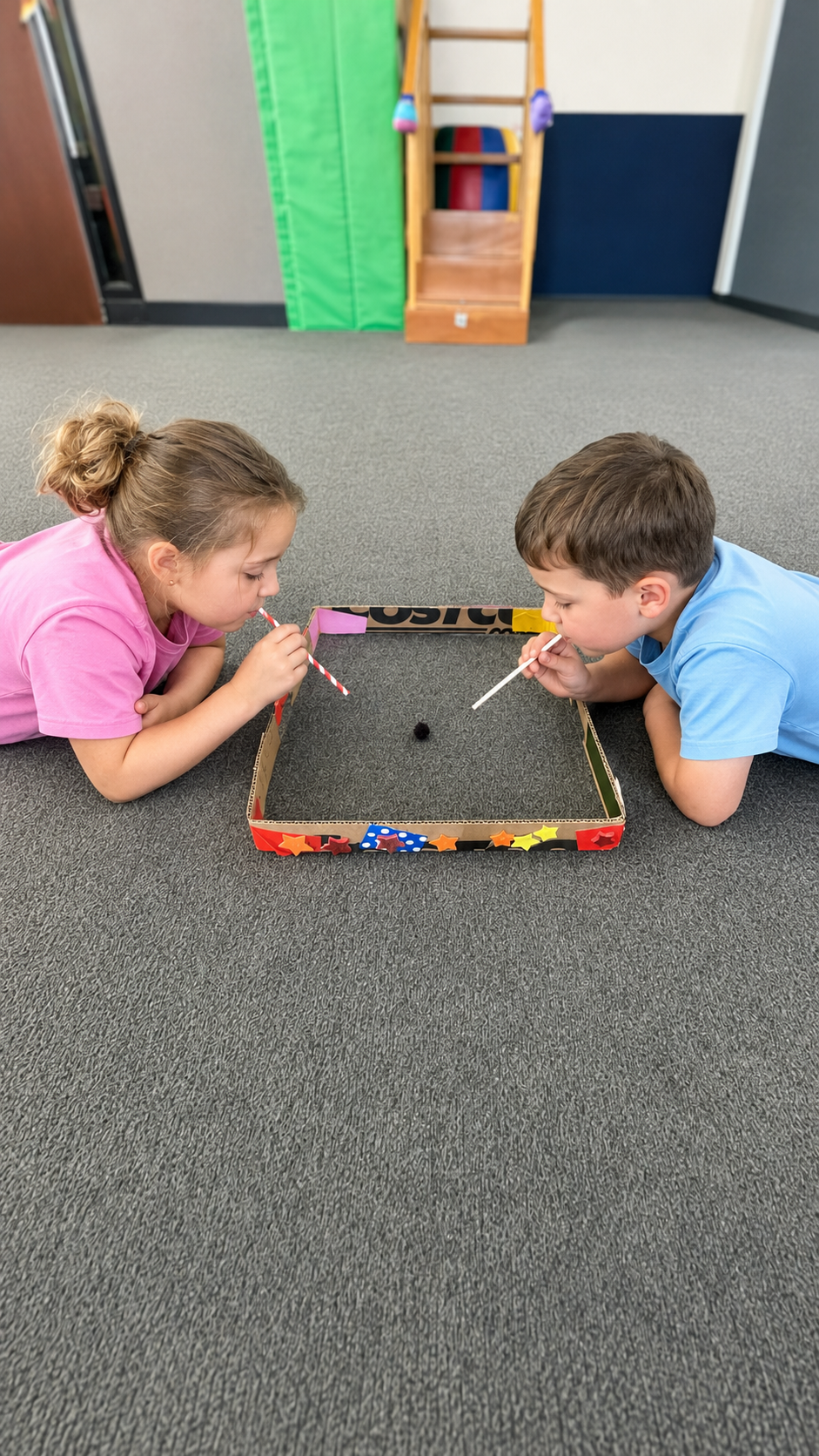
Speech therapy at MOCO may include focused, structured practice, but the work does not stay there. We bring communication goals into movement, play, conversation, daily routines, and interactions with others so children can use their skills in the places that matter. A child working on requesting and turn-taking might be doing it halfway through an obstacle course. A child working on articulation might be doing it in the middle of a game they actually want to win.
That's intentional. Children are often better able to access communication when they feel safe, connected, regulated, and motivated. Based on this framework, the therapists build sessions around a child's real interests and let the language work happen inside that, not around it.
Applied Functional Therapy and Communication
Applied Functional Therapy (AFT) is MOCO's approach to pediatric therapy and the clinical reasoning framework our speech-language pathologists use to help children turn communication skills into meaningful participation in everyday life. We consider what the child wants or needs to communicate, what may be making that difficult, and which supports involving speech, language, movement, regulation, attention, sensory processing, motor planning, AAC, relationships, or the environment may help.
Communication does not develop in isolation. A child's ability to speak, understand language, use an AAC system, participate in conversation, or communicate during daily routines may be influenced by posture, breathing, movement, regulation, sensory needs, confidence, and access to supportive communication partners. Because MOCO's pediatric SLPs, occupational therapists, and physical therapists work together under one roof, they can address these connections as part of a coordinated plan of care. For example, an SLP may collaborate with a child's OT to understand how regulation affects communication or with a PT to improve positioning and access to an AAC device.
Some communication skills may first need to be introduced or practiced in a quiet, structured setting. Our goal is to help the child gradually access, adapt, initiate, and use those skills in more complex situations, such as the classroom, playground, family routines, or community activities.
AFT also guides how we evaluate the benefit of speech and language therapy and determine the next steps in the child's plan of care. We measure progress through objective clinical information, therapist observation, and reports from children, families, caregivers, and other members of the child's team. Meaningful progress may look like being better understood, expressing a need, repairing a communication breakdown, telling someone what happened, ordering food, joining a game at recess, advocating for help, or participating more fully at home, at school, and in the community.
Areas We Evaluate and Treat
Our speech-language pathologists evaluate and treat:
Articulation & Speech Sound Development
Producing and organizing speech sounds clearly, including sounds that are hard to produce, or that get substituted, dropped, or simplified past the age you'd expect
Receptive & Expressive Language
Understanding what's said, and finding the words to respond
Early Language Development
First words, first sentences, and everything that builds toward them
Stuttering & Flow of Speech
Repetitions, prolongations, blocks, or tension that may affect communication comfort and participation
Childhood Apraxia of Speech
Difficulty planning and sequencing the movements needed to produce clear and consistent speech
Motor Speech Disorders
Coordination and control of the muscles used for speech
Social Communication
Starting and maintaining interactions, sharing ideas, understanding others, repairing communication breakdowns, and advocating for needs
Voice
How a child's voice sounds, and the habits behind it
Selective Mutism
Supporting functional communication for children whose anxiety makes speaking difficult in particular people, places, or situations
Augmentative and Alternative Communication (AAC)
Tools that give non-speaking, minimally speaking, and emerging-language children a way to be heard
Reading & Written Language
Early literacy, phonological awareness, decoding, comprehension, and executive functioning skills
Language Organization & Executive Skills
Organizing ideas, sequencing information, planning what to say, remembering directions, and telling a clear story
Support for Deaf & Hard of Hearing Children
Developing language, communication access, self-advocacy, and effective interaction across settings
Feeding & Swallowing
Developing safe, efficient, and functional skills for eating and drinking, including oral-motor skills for chewing and swallowing, expanding food repertoires, and improving mealtime participation
AAC and Multimodal Communication
There's no single AAC system that fits every child, so we don't push one. We support a wide variety of AAC tools: speech-generating devices, apps on a tablet, core boards, picture-based systems, low-tech supports, and alternative access methods for children who need them. AAC isn't only for children who are non-speaking. It also supports children with emerging language, helping them build vocabulary and communicate more reliably while their spoken language continues to develop. The best-fit system supports the child's communication needs, preferences, access abilities, environments, and communication partners. When needed, our SLPs collaborate with MOCO's occupational and physical therapists to consider positioning, motor access, vision, reach, switch access, fatigue, and how the child will use the system throughout the day.
AAC is not a replacement for communication. It is communication.
Our SLPs handle evaluations, device trials, system setup, and training for families and caregivers, and we coordinate with schools and outside teams so the system travels with the child. Then we do the part that matters most: putting AAC into play, movement, snack, and conversation with peers, so it works in real life and not only in a session.

Early Communication
Early communication is the ground floor for learning, connection, regulation, and everything that gets built later. When families have questions about early communication, an evaluation can help clarify a child's strengths, identify what may be getting in the way, and determine whether additional support would be helpful. Early intervention gives families practical strategies they can use during the routines already happening every day.
We work with infants, toddlers, and preschoolers on gestures, signs, first words, and functional communication that gets a real result at home. Much of this work is with you, not just with your child, because families and caregivers support communication throughout the other 167 hours of the week. We'll show you what to do at bath time, in the car, and at dinner, and then we'll adjust it when it doesn't go the way we planned.
If your child is already working with Montgomery County Infants and Toddlers, we're glad to coordinate. More on that on our Early Intervention page.
Communication for School-Aged Children and Teens
Early is good. Later is still worth doing. We work with preschoolers, school-aged children, and teens on language comprehension, expressive language, literacy, executive functioning, social communication, classroom participation, peer interaction, and self-advocacy.
As children grow, communication demands become more complex. Group projects, classroom discussions, presentations, friendships, reading, written work, planning, and self-advocacy may reveal needs that were less noticeable earlier. Goals may include explaining an idea, following a fast-moving conversation, asking for clarification, organizing schoolwork, navigating a disagreement, advocating for accommodations, or communicating more independently in the community.

Feeding
Feeding challenges can affect the whole family. Our SLPs help children build the skills needed to participate more safely, comfortably, and successfully in meals. Depending on the child's needs, therapy may address biting, chewing, drinking, managing different textures, pacing, positioning, and communicating during meals.
Goals are individualized and may include safety, efficiency, comfort, nutrition, flexibility, independence, and participation at the family table. When a concern falls outside what a feeding evaluation can address, we coordinate with the child's medical team as needed.
Language-Based Literacy
Reading and written language depend on many of the same sound, vocabulary, comprehension, and language-organization skills addressed in speech-language therapy. Children who struggle with sound awareness, decoding, comprehension, or organizing what they want to write are often working on the same underlying skills we address in speech therapy.
Our SLPs support early reading, phonological awareness, decoding, comprehension, and the executive functioning that goes with language-based learning. Same approach as everything else: multisensory, movement-friendly, and built around something the child cares about.
Evaluation, Family Partnership, and Carryover
Every plan begins with a comprehensive evaluation that brings together formal assessment, clinical observation, caregiver input, the child's perspective when possible, and an understanding of participation at home, school, and in the community. We want to understand not only what is difficult, but what the child is trying to do, what is getting in the way, and what supports may help.
That evaluation becomes the plan: your child's strengths, what's getting in the way, how they communicate now, and what your family wants to see change. Families and caregivers carry a lot of this forward between sessions, so we build in real-world carryover from day one, home strategies, school connections, and the routines you're already doing, rather than treating carryover as an afterthought.
Families we serve often ask about financial assistance for AAC devices and other equipment. See our full Community Resource Guide.
Collaborative Care
We also coordinate with the people already in your child's corner: pediatricians, schools, early intervention teams, and outside therapists. Communication goals work better when everyone is pulling in the same direction.

Serving Families Across Montgomery County
MOCO Movement Center is located in Kensington, MD, and sees children and families from throughout Montgomery County, including Bethesda, Silver Spring, Rockville, Gaithersburg, and Potomac, as well as Prince George's and Howard Counties, Washington, DC, and the greater DMV.
What Montgomery County Families Say About MOCO Speech Therapy
"We have been bringing our son to MoCo for his speech therapy and Occupational therapy. We are so proud of the progress he has made. His speech, social, and behavior has improved tremendously over the past 5 years. Each therapist made a tailored plan for son which was really great. His ability to work with different therapists who understand his plan is also a great way the therapists communicate with each other."
— Yetty | Google Review
"We have been going here for years and can't say enough great things about everyone here, from the director to the therapists to the admin staff. It feels like a family here. The therapists are fun, engaging, and knowledgeable and the gym has many fun activities that my son enjoys. Everyone really cares, here, and parents are involved in the process. We've seen OT, PT, and speech and have been happy with all of our providers over the years. Actually cried when we just said goodbye."
— Michelle | Yelp
"My kiddo loves going OT and Speech at Moco. He makes great progress because the staff engage him in therapy through play and real world skills. His favorite days are MOCO days."
— Carrie | Google Review